Before choosing a mobile crusher, make sure buying one makes sense for your project.
If your project is short-term and you have no other jobs lined up, renting equipment or hiring a contractor may save you more money than buying. A mobile crusher makes more sense when you need to move between sites, work in remote locations, process material on site, or follow a moving working face.
If you plan to operate at the same quarry for 10 years and process millions of tons of rock, a stationary crushing plant may offer a lower long-term cost.
How can a mobile crusher help you save money?
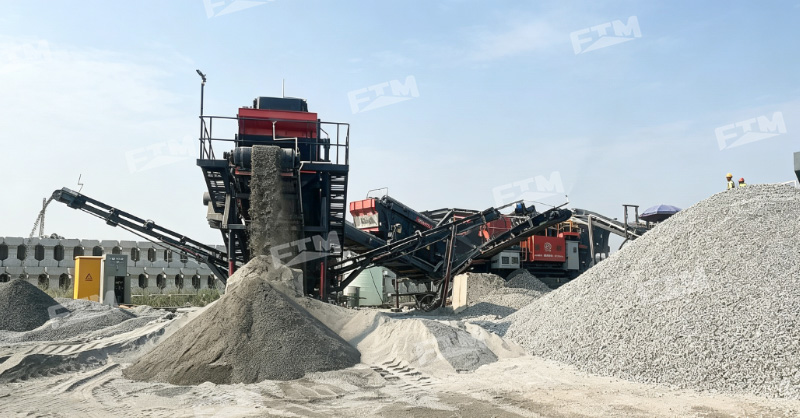
- Less hauling: You crush the rock right where you blast it. This saves you thousands of dollars in diesel and truck wear every month.
- Less site construction: A mobile crusher sits right on compacted ground. You unload it, and you can start crushing in a few hours.
- Faster relocation: You can drive or tow the machine right to the rock pile. "Where the work is, that's where you drive it."
- One plant, multiple configurations: A single mobile platform can be configured with jaw, impact or cone crushers, screens and sand-making equipment for different applications.
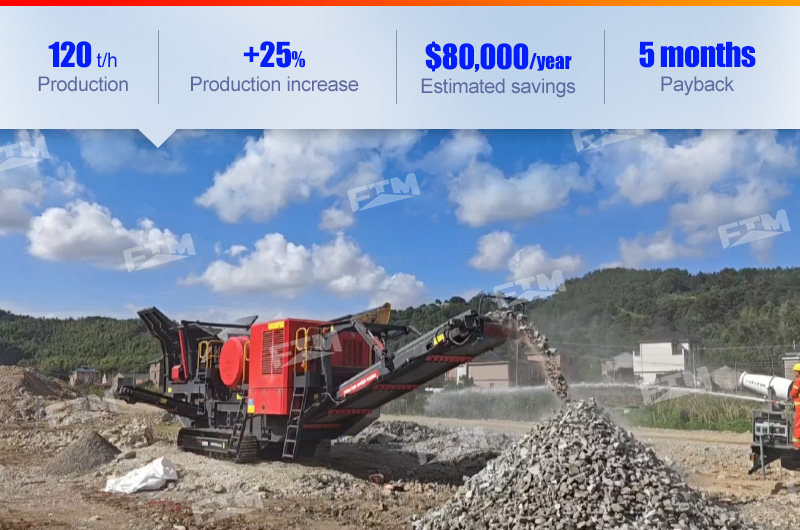
Australian project: 120 t/h granite crushing
FTM Machinery supplied a 120 t/h mobile crushing plant for a granite project in Australia. By crushing the rock directly at the quarry site, the customer produces crushed aggregate for local road base applications.
Compared with the previous setup, the new plant increased production by 25% while reducing hauling and operating costs, with estimated annual savings of $80,000. The investment is expected to pay back in about 5 months.
Which type of mobile crusher should you buy?
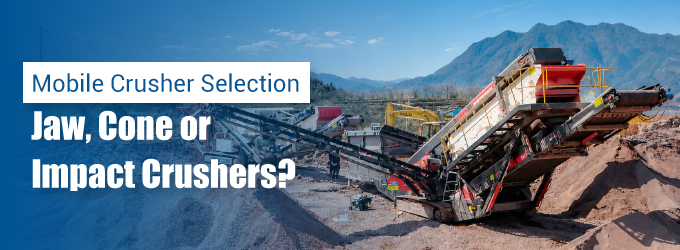
FTM Machinery offers three main types of mobile crushers: jaw, impact and cone.
Three types, three jobs. Choosing the wrong crusher can mean costly changes later.
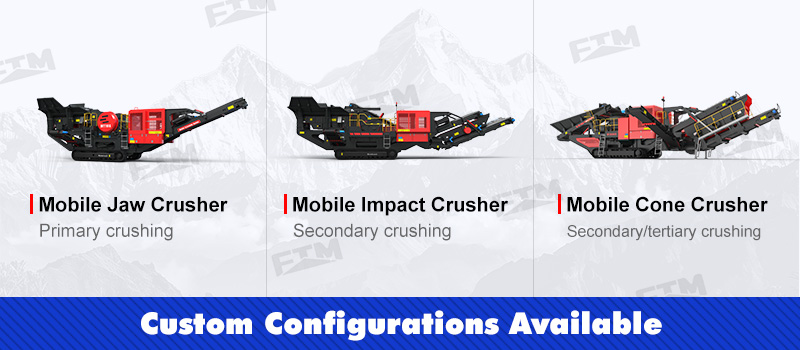
| Requirement | Mobile Jaw Crusher | Mobile Impact Crusher | Mobile Cone Crusher |
| Main job | Primary crushing | Secondary crushing | Secondary/tertiary crushing |
| Best suited for | Hard, abrasive rock such as granite, basalt and quartz | Soft to medium-hard rock and recycled materials such as limestone and concrete | Hard, abrasive rock and river gravel |
| Capacity range | 85–650 t/h | 70–280 t/h | 50–300 t/h |
| Typical feed size | Large feed, up to about 500–800 mm depending on model | Medium feed, about 200–700 mm depending on model | Small to medium feed, about 200–450 mm depending on model |
| Product shape | Coarser, less cubical | Excellent cubical shape | Consistent, high-quality aggregates |
- Mobile jaw crusher: Handles large feed sizes with ease, making it a strong choice for primary crushing of hard rock such as granite and basalt.
- Mobile impact crusher: Produces well-shaped, cubical aggregates and works well with soft to medium-hard rock. However, highly abrasive materials such as granite and river gravel can cause faster wear of the impact plates and blow bars.
- Mobile cone crusher: A good choice for high-capacity hard-rock crushing in secondary and tertiary stages. It delivers consistent product sizes but requires a stable feed and proper operating conditions.
FTM's mobile crushers cover a wide range of capacities, from compact units for smaller stone crushing projects to high-capacity models for large quarries. Get a Free Recommendation
Tracked or wheeled — Quick pick
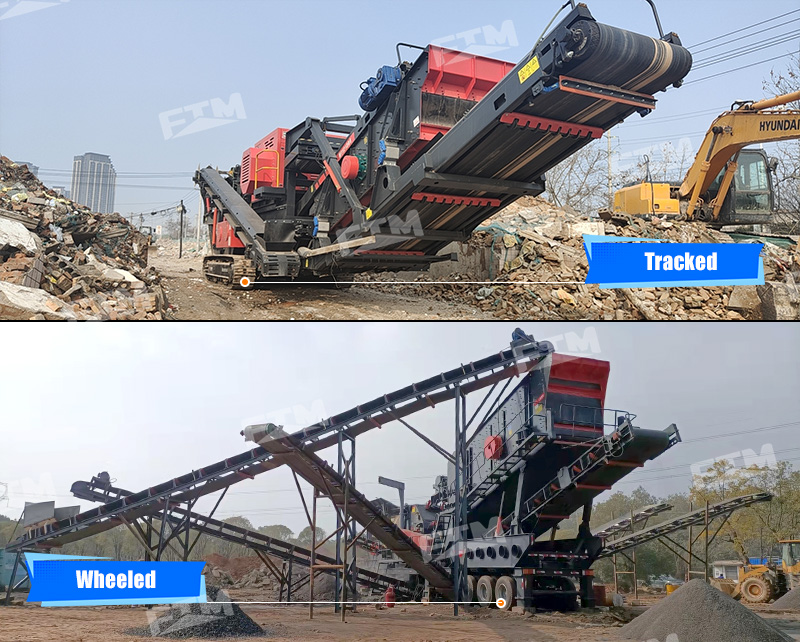
Tracked — Best for moving around the site. It can travel between work areas on rough or uneven ground under its own power. The downside is that it usually needs a truck for transport to another project.
Wheeled (semi-mobile) — Best when road transport between projects matters more. It is easier and less expensive to move over longer distances, but needs suitable ground and some site setup.
A simple rule of thumb: if you need to move frequently around a rough job site, go tracked. If you mainly move between different sites by road, go wheeled.
One mobile crusher or a complete mobile crushing plant?
The key question is whether you only need to crush the material or need to produce finished, correctly sized products on site.
One mobile crusher can be enough when the main job is primary crushing. For example, large granite, basalt or ore can be reduced to a smaller size and sent to fixed equipment or another processing stage.
A mobile crusher plus a mobile screen is a better fit when you need finished products on site. The screen separates the crushed material into different sizes so they can be sold or used directly.
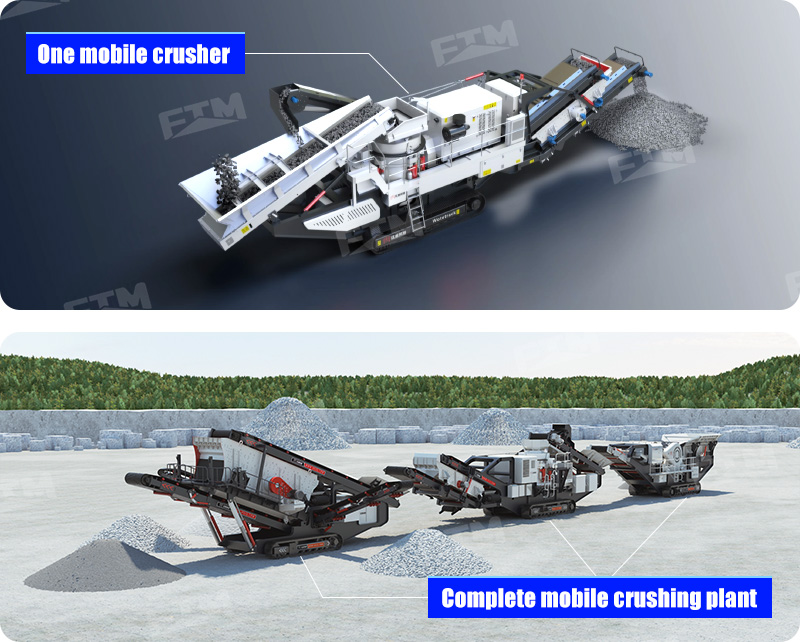
For hard-rock quarries and high-spec aggregate production, a common setup is a mobile jaw crusher + mobile cone crusher + mobile screen. The jaw crusher handles the primary crushing, the cone crusher reduces the material further, and the screen separates the final products. Oversize material can be returned to the crusher to form a closed circuit.
For limestone, concrete, asphalt and construction waste, another common option is a mobile jaw crusher + mobile impact crusher + mobile screen. The impact crusher is particularly useful when better particle shape is required.
Common mobile crushing setups by capacity Contact Our Sales Experts
| Required Output | Typical Project | Possible Configuration |
| 30–80 t/h | Small recycling or aggregate projects | Compact mobile jaw or impact crusher |
| 80–150 t/h | Small quarries, road base and C&D recycling | Mobile jaw or impact crusher |
| 150–300 t/h | Medium quarries and commercial aggregate plants | Mobile jaw + cone/impact crusher + screen |
| 300–500 t/h | Large quarries, road and infrastructure projects | Multi-stage mobile crushing and screening |
| 500+ t/h | Large quarries or mining operations | Multiple high-capacity mobile crushers |
These ranges are for initial planning only. The final setup depends on the material, feed size, required products and crushing process.
How large should your mobile crusher be?
Rated capacity is not the same as actual output. If you need 200 t/h of saleable aggregate, a crusher rated at 200 t/h may not be enough.
A simple planning estimate is:
Required rated capacity ≈ Required saleable output ÷ Expected utilization
For example, if you need 200 t/h of saleable aggregate and expect 80% utilization:
200 ÷ 0.80 = 250 t/h
This is only a starting point. Final equipment sizing depends on the material, feed size, reduction ratio, screening and recirculating load.
When sizing a mobile crusher, it also helps to know:
- Maximum feed size — e.g. 500 or 700 mm
- Target output — e.g. 50 or 300 t/h
- Final product sizes — e.g. 0–5, 5–10, 10–20 and 20–31.5 mm
- Material properties — hardness, abrasiveness, moisture and clay content
- Crushing process — single-machine/open circuit or crushing, screening and return in a closed circuit
Only have some of this information? That's fine. Start with what you know, and we can work out the rest with you.
How much does a mobile crusher cost?
At FTM Machinery, you don't need to overpay for a reliable, heavy-duty machine.
With over 40 years of manufacturing experience, FTM Machinery sells factory-direct, helping customers get the equipment they need without the markup associated with major international brands.
FTM Machinery Mobile Crusher Price Guide:
- Wheel-mounted mobile crushers: Ranging from $80,000 to $300,000. These are easy to tow between job sites with a standard road tractor.
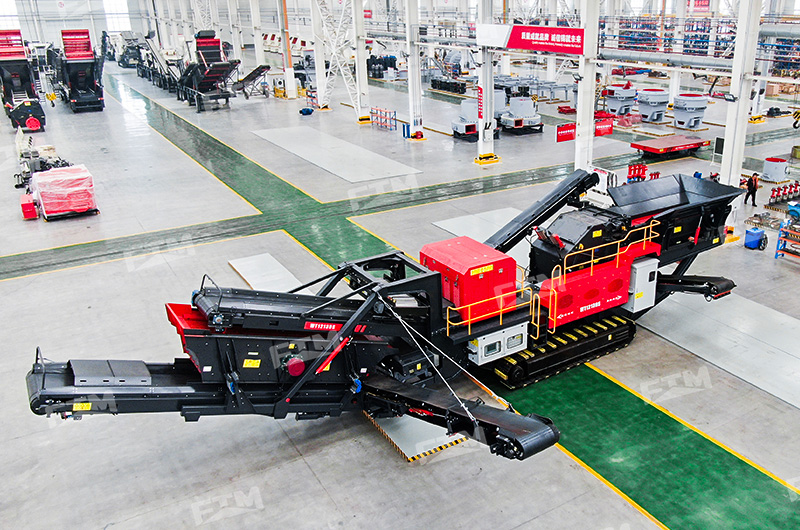
- Tracked mobile crushers: $100,000–$400,000+. They can move independently across rough, muddy or uneven job sites without relying on a towing vehicle.
What drives the price?
- Tonnage (TPH): Higher output usually requires a larger crusher and power system.
- Tracks vs. wheels: Tracked machines cost a bit more because of the heavy-duty hydraulic drive system, but they offer better mobility on rough terrain.
- Power options: Diesel-hydraulic systems are useful for sites without reliable grid power. Where grid electricity is available, dual-power systems can reduce diesel use and operating costs.
Note: Prices above are for reference only. Final pricing depends on your required configuration, capacity, destination, and project specs.
Final thoughts
A mobile crusher makes the most sense when the job needs to move, hauling costs are high, or a fixed plant simply isn't practical. The real savings come from keeping the crushing process closer to where the material is being worked.
The right machine is not necessarily the biggest or the cheapest. It is the one that makes sense for the way you operate.
Ready to choose your mobile crusher?
FTM Machinery provides mobile crushing equipment and complete plant solutions for quarrying, construction and recycling applications. Contact Us