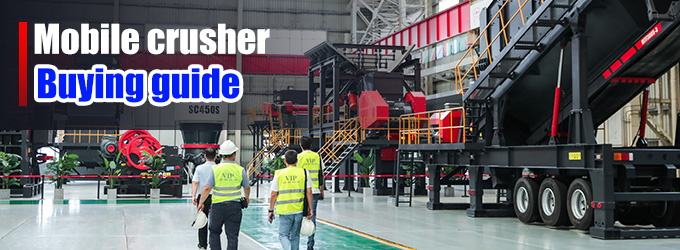
From an investment-return perspective, mobile jaw crushers can replace stationary crushing plants for C&D (Construction & Demolition) waste recycling, aggregates production and mining operation. They work especially well for scattered short-term open-pit mines and regions without convenient power supply.
Compared with stationary crushing plants, mobile jaw crushers can reduce the overall project cost by 20–45%, making them a superior choice.
There are two main types of mobile jaw crushers: track-mounted units and wheel-mounted units.
Track-mounted mobile jaw crusher
Track-mounted mobile crushers are widely used for ore mining, hydropower projects, tunnel muck disposal and other remote off-grid job sites.
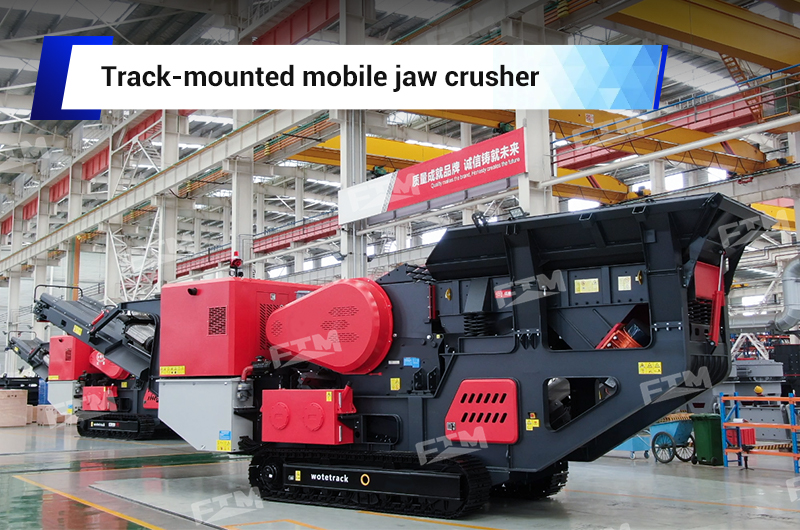
Unique working-condition advantages:
- Capable of off-road travel and climbing gradients up to 1:10.
- Self-propelled on muddy and swampy ground.
- Operable under extreme cold conditions down to -25 °C.
- High mobility with on-site spot-turning capability.
- Centralized control system ensures simple operation, along with convenient maintenance and inspection.
It normally comes with higher upfront purchase cost. Tracks are wear-prone components and will generate replacement expenses in later operation.
Wheeled-mobile jaw crusher
The wheeled mobile jaw crusher requires towing by a trailer for relocation. It is well-suited for scenarios such as demolition solid-waste processing, highway infrastructure construction, construction-waste recycling, and airport expansion.
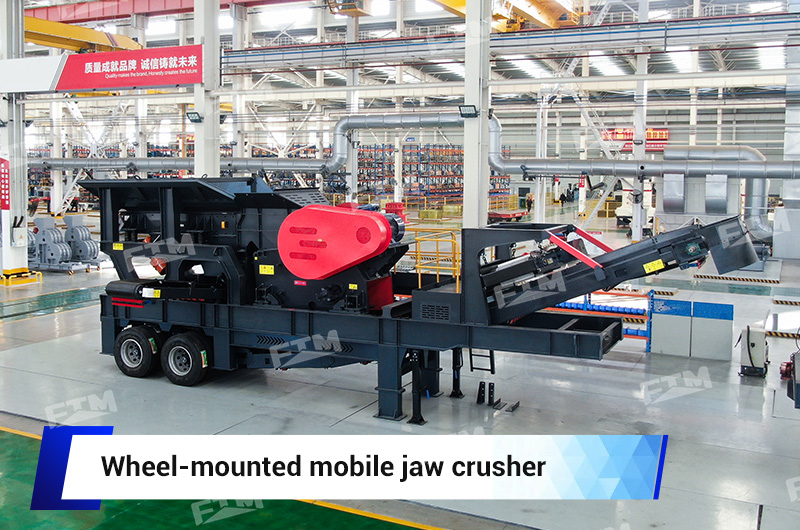
It comes with the following advantages:
- Compared with track-mounted crushers, it comes with lower purchase costs, cutting investment by 20%–40%.
- It delivers fast, convenient movement on flat-site ground conditions.
- The control system intelligently tracks internal machine wear to minimize downtime losses.
It is not capable of off-road travel and cannot travel long distances on-site on its own.
They are all equipped with diesel generator sets and support two power modes: pure-diesel mode and dual power of diesel plus mains electricity. In remote areas without power supply, there is no need to spend high costs on power grid installation.
Mobile jaw crusher feed size, output size & capacity
After blasting operations at mines, raw rock materials are usually large in size. The average block size ranges from 200–400 mm, and oversized lumps of 500–700 mm are very common.
FTM Machinery mobile jaw crushers feature large and flexible feed-opening designs. Raw rocks can generally be fed directly into the machine for crushing without pre-processing.
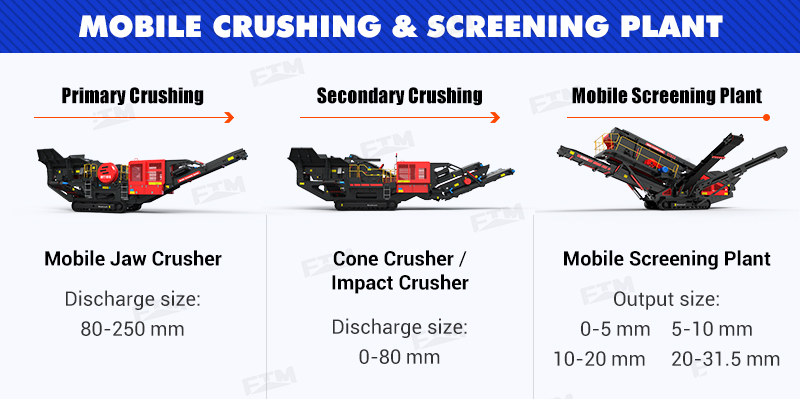
Materials discharged from the jaw crusher have particle sizes of 80–250 mm. They can go straight into secondary crushers such as cone crushers and impact crushers for further crushing, enabling smooth connection across the whole crushing process.
FTM Machinery mobile jaw crushers support flexible matching of crushing main units according to project capacity requirements. This helps you avoid project delays caused by insufficient output, as well as unnecessary costs resulting from over-capacity configuration.
Below are our popular main crusher models:
| Main Crusher Model | Feed Opening Size | Max Feed Size | Capacity |
| CJ96 | 930 × 580 mm | 480 mm | 70–150 t/h |
| CJ106 | 1,060 × 700 mm | 560 mm | 130–280 t/h |
| CJ120 | 1,200 × 870 mm | 700 mm | 280–650 t/h |
How to configure a mobile jaw crushing production line?
Mobile jaw crushing stations normally integrate a feeder, jaw crusher, conveyor system, power unit and electric-control system.
Optional add-ons such as magnetic separators, generator sets, enlarged hoppers or extended conveyor belts can be configured based on project requirements.
For projects requiring multi-stage crushing and screening, secondary mobile crushing stations and mobile screening stations can be added to build a complete mobile crushing production line. The typical workflow is:
Mobile jaw crushing station → Secondary mobile crushing station → Mobile screening station
With multi-stage crushing and screening, aggregates of different sizes including 0–5 mm, 5–10 mm, 10–20 mm and 20–31.5 mm can be produced as needed.
Core Configuration Principles:
- High-hardness abrasive materials (granite, basalt, diabase, river pebble, iron ore): Mobile jaw crusher + mobile cone crusher + mobile screening plant. Avoid impact crushers. They cause extremely high wear-part consumption and blow up project budgets.
- Brittle medium-soft materials (limestone, dolomite, construction waste): Mobile jaw crusher + mobile impact crusher + mobile screening plant. This combination delivers good finished-product particle shape with lower capital investment.
If manufactured sand is required, add a vertical-shaft impact crusher at the downstream end for shaping and sand-making.
Important note: The processing capacity of the jaw crusher should be 10–20 % higher than that of the secondary crusher. This capacity margin prevents overload of secondary-stage equipment.
| Capacity Range | Processed Materials | Complete Mobile Plant Configuration |
| 50–80 TPH | Construction waste, limestone, tunnel muck | Track-mounted / wheel-mounted jaw crusher + mobile impact crusher + mobile screening plant |
| Granite / basalt / river pebble | Track-mounted / wheel-mounted jaw crusher + compact mobile cone crusher + mobile screening plant | |
| 100–150 TPH | Limestone, dolomite, construction waste | Mobile jaw crusher + mobile impact crusher + mobile screening plant |
| Granite, basalt, diabase, river pebble, iron ore | Mobile jaw crusher + mobile cone crusher + mobile screening plant | |
| 180–250 TPH | Hard rock (granite, basalt, river pebble) | Mobile jaw crusher + mobile cone crusher + mobile screening plant. Add VSI crusher if sand-making is required. |
| Limestone, brittle stone materials | Mobile jaw crusher + mobile impact crusher + mobile screening plant | |
| 280–400 TPH | High-hardness ore and rock | Large-feed-opening mobile jaw crusher + multi-cylinder mobile cone crusher + heavy-duty mobile screening plant. VSI sand-making crusher is optional. |
Working lifespan of mobile jaw crusher
The main crusher is the core component. Its quality directly governs service life and failure rates. FTM mobile crushers feature an average service life of 8–15 years.
Key factors influencing main-unit service life:
- Movable & fixed jaw plate material: FTM Machinery provides jaw plates in manganese steel, alloy steel and composite materials for hard-rock and soft-rock applications.
- Frame design: One-piece cast-steel frames (instead of welded frames) deliver high impact resistance and durability, operating stably with 400–700 mm granite feed.
- Eccentric shaft & bearings: Larger-spec bearings pair with heavy-duty eccentric shafts. They resist overheating and fracture under impact, reducing failures for long-term hard-rock crushing.
- Overload protection: Integrated hydraulic overload protection avoids equipment damage and costly downtime from tramp-iron ingress.
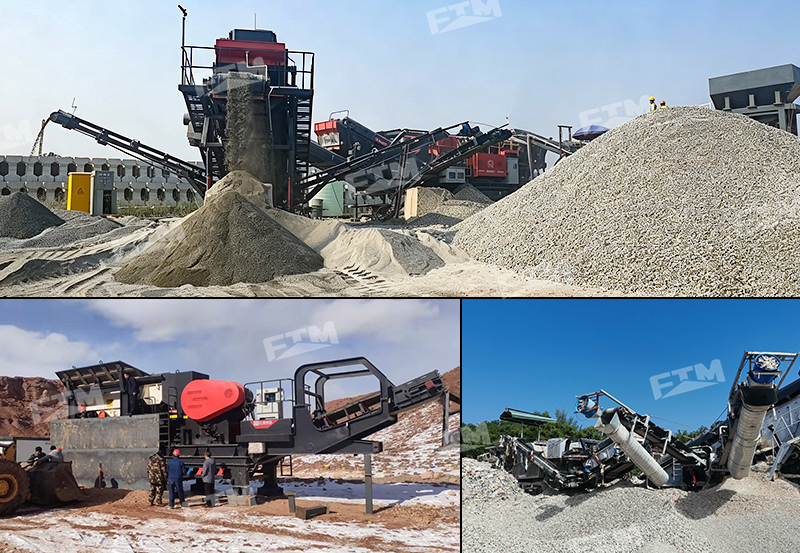
Mobile jaw crusher price
Machine configurations and prices vary depending on crushed materials and target output capacity.Get Factory Quotation
| Capacity | Wheel-mounted mobile jaw crusher | Track-mounted mobile jaw crusher |
| 50–80 t/h | $65,000–120,000 | $110,000–170,000 |
| 100–150 t/h | $110,000–200,000 | $150,000–250,000 |
| 180–250 t/h | $210,000–320,000 | $270,000–420,000 |
| 280–500 t/h | $320,000–480,000 | $420,000–620,000 |
Besides the machine purchase cost, you need to include the following items in your budget.
- Site preparation cost: Only basic ground leveling is needed. Heavy civil construction is not required.
- Energy cost: Diesel fuel or grid electricity expenses.
- Wear-part replacement: Jaw plates, liners and conveyor belts. Track pads are extra for track-mounted models.
- Maintenance consumables: Hydraulic oil, lubricants and filter elements.
- Labor cost: Wages for operators and maintenance workers.
- Relocation cost: Track-type units move under their own power. Wheel-type units require an external trailer truck.
Your concerns about mobile jaw crushers
1. Is the capacity over-rated?
- With over 40-years manufacturing experience, all technical parameters are verified by real-site projects. Precisely matched eccentric shaft and bearings guarantee stable heavy-duty performance. Our machines are exported to more than 100 countries.
2. How about installation & commissioning?
- Turn-key service includes solution design, installation guidance, no-load & load test running, and operator training for independent operation.
3. Worry about blockage and slow spare-parts supply?
- Year-round technical support: remote guidance within 30 min. On-site engineer arrangement for serious breakdowns. 12-month warranty plus lifetime technical support. Fast original spare-parts delivery to minimize downtime.
4. Can it work without stable grid power?
- Diesel-only or dual-power (diesel + electric) options are available. Save fuel with grid power, switch to diesel for off-grid sites. Voltage and electric protection can be customized for local standards.
5. Limited budget, afraid of overpaying?
- We respect your budget and will not push over-spec configurations. Core component reliability is guaranteed while unnecessary options can be removed. Multiple proposals are offered for your selection. Get better quality and service at comparable cost.