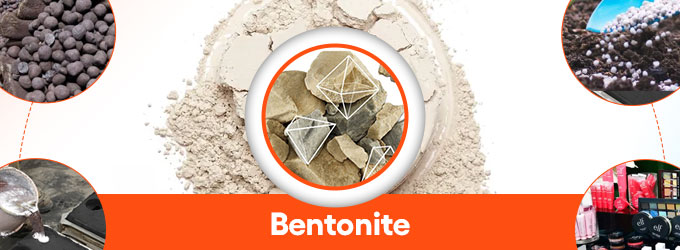
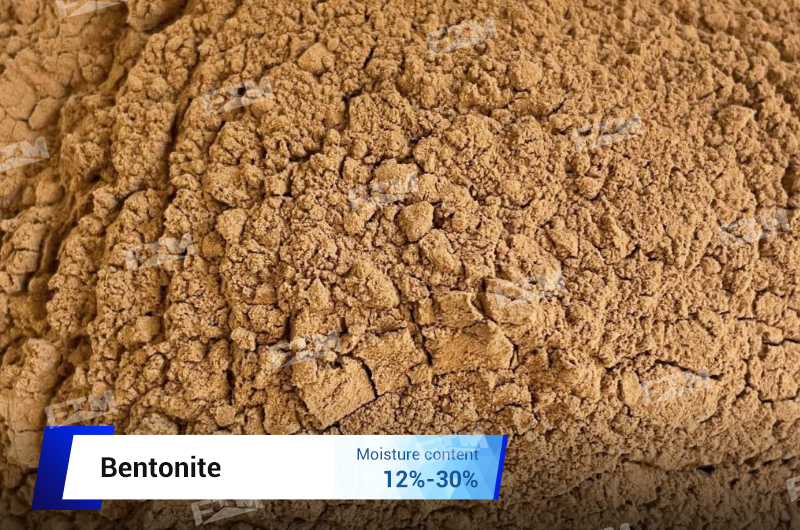
Raw bentonite ore has a moisture content of 12%–20%, sometimes reaching 30%, which makes it prone to clumping when damp. It can be used for bonding, sealing, soaking up and greasing.
A bentonite grinding plant is the best choice for processing raw bentonite into high-quality bentonite powder.
The bentonite grinding plant can produce bentonite powder in different fineness levels without secondary processing, achieving integrated powder production with high efficiency.
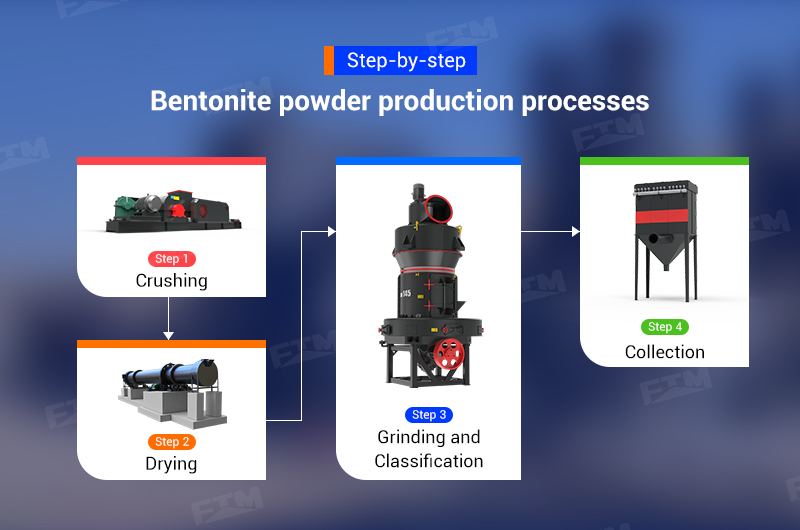
Step-by-step bentonite powder production processes
The main processes for grinding bentonite powder in bentonite grinding plant are as follows:
Crushing → Drying → Grinding and Classification → Collection
Step 1: Crushing
First, a roller crusher is used to crush the raw bentonite ore into medium-sized blocks, which is easy to subsequent drying and grinding.
Step 2: Drying
A clay dryer is used to dry the bentonite, reducing its moisture content and preventing material blockage in subsequent processes.
Step 3: Grinding and Classification
The dried bentonite blocks are fed into a grinding mill for pulverization. The generated airflow then sends the bentonite powder into a classifier for screening, and the substandard powder is returned for re-grinding.
Step 4: Collection
Qualified bentonite powder enters the powder collector with the airflow for subsequent packaging. The dust generated during this process is collected by the pulse jet dust collector.
3 top bentonite grinding equipment types
Bentonite powder of different fineness is used in different application fields:
| Bentonite fineness | Application industries | Functions |
| 80–150 mesh | Fertilizer, agricultural soil improvement | Adjusting soil pH value |
| 100–200 mesh | Cat litter, foundry binders | Delivering strong water uptake capacity |
| 200 mesh | Drilling mud | Increasing mud viscosity |
| 200–325 mesh | Organic clay, cosmetics | Serving as a thickener |
| 325–800 mesh | Paper filler, chemical additive | Acting as retention aid and stabilizer |
FTM Machinery offers three types of grinding mills to meet various fineness requirements.
1. Raymond mill
Raymond mill is the most traditional bentonite grinding mill and is widely used in the processing industry.
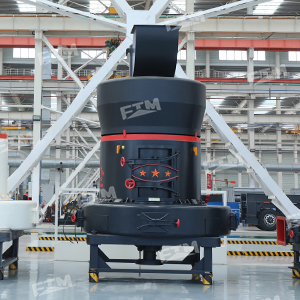
Maximum feed size: ≤30 mm.
Capacity: 1–22 t/h.
Output size: 0.173–0.044 mm (80–325 mesh).
The advantages of FTM Machinery's Raymond mill include:
- Low investment: Raymond mills are cost-effective, suitable for small to medium-scale production investments.
- Quick installation: Modular design is quick and easy to assemble. Simplified installation saves construction time.
- Low commissioning difficulty: The mature and stable mechanical structure allows for rapid output after installation, reducing downtime.
Our best-selling Raymond mill model:
| Model | Feed particle size (mm) | The finished product fineness |
| 4525 | ≤30 | 0.173–0.044 mm (80–325 mesh) |
| 4119 | ≤25 | 0.173–0.044 mm (80–325 mesh) |
2. Ultrafine grinding mill
The ultrafine grinding mill is an upgraded version of the Raymond mill. Although both of them operate on the same principle, the ultrafine grinding mill produces finer powder compared to the Raymond mill.
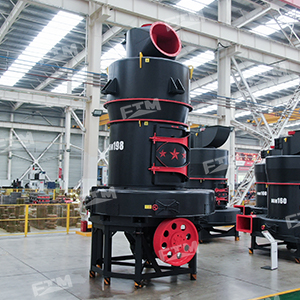
Maximum feed size: <40 mm.
Capacity: 0.4–40 t/h.
Output size: 0.25–0.015mm (60–800 mesh).
Advantages of the ultrafine grinding mill:
- Using a high-efficiency cage classifier: It allows for flexible adjustment of the finished product fineness.
- Low noise: The flexible connection between the classifier and the main housing reduces noise and vibration.
- Wide fineness adjustment range: It can reach a fineness of up to 800 mesh, far exceeding the output fineness of other mills.
- Low maintenance cost: The grinding rollers and wear-resistant blades are made of high-strength wear-resistant steel, resulting in a longer service life and maintenance costs that are more than 50% lower than traditional Raymond mills.
Our best-selling ultrafine grinding mill include:
| Model | Feed particle size (mm) | The finished product fineness | Capacity (t/h) |
| HGM100 | <25 | 0.25–0.015 mm (60–800 mesh) | 0.8–10 |
| HGM190 | <40 | 0.25–0.038 mm (60–400 mesh) | 5–40 |
3. Vertical mineral grinding mill (Vertical roller mill)
Our self-developed vertical mill is a highly efficient solution for large-scale bentonite grinding.
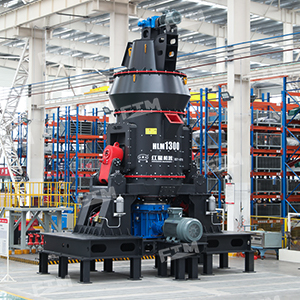
Maximum feed size: <10 mm.
Capacity: 10–320 t/h.
Output size: 0.84–0.37 mm (20–400 mesh).
The finished product moisture: ≤1%.
Advantages of vertical mineral grinding mills:
- High output: Compared to other mills, this machine can produce up to 320 t/h.
- Drying capacity: Fitted with hydraulic system, it performs grinding, grading and drying efficiently, cutting bentonite moisture from 15% to 1–5%.
- High grinding efficiency: The mill has an inclined design, which increases the contact area with the material and prevents large pieces of material from clogging the air inlet.
Our best-selling vertical mineral grinding mill include:
| Model | The raw material moisture | The finished product moisture | The finished product fineness | Capacity (t/h) |
| HLM1300K | ≤15% | ≤1% | 0.84–0.37mm (20–400 mesh) | 10–40 |
| HLM2200K | 35–135 | |||
| HLM3700K | 90–320 |
How to choose a suitable bentonite grinding mill?
Choose the right bentonite grinding mill based on your project requirements:
1. Target fineness
- For a fineness below 325 mesh, a Raymond mill or vertical mineral grinding mill can be selected.
- For a fineness between 325–800 mesh, an ultrafine grinding mill should be selected.
2. Capacity
- If you need around 20 tons/hour, a Raymond mill or ultrafine grinding mill can be selected.
- If you need 40+ tons/hour, a vertical mineral grinding mill should be selected.
- If you need lower capacity but higher fineness, an ultrafine grinding mill can be selected.
3. Bentonite moisture content
- If the bentonite moisture content is too high, a dryer must be used before grinding, and then a Raymond mill or ultrafine grinding mill can be selected.
- If the bentonite moisture content is below 15%, a dryer can be omitted, and a vertical mineral grinding mill can be selected directly.
Ready to get your bentonite grinding solution?
The grinding production plant enables customized bentonite processing to achieve all desired fineness levels, reducing labor costs and ensuring more stable production capacity. It brings high returns and low costs to your project.
We have helped hundreds of clients worldwide establish suitable bentonite grinding plants. Come and get your bentonite grinding plant solution now! Contact us