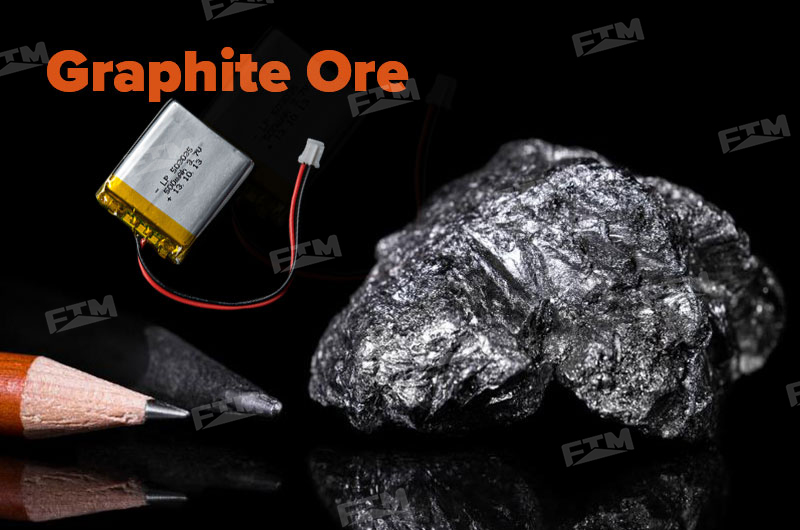
Graphite ore processing plays a critical role in producing high-quality graphite for battery and industrial use. With global demand driven by electric vehicles, the need for high-purity graphite is projected to grow by nearly 500% by 2050.
Whether processing crystalline flake graphite or amorphous ore, a well-designed processing line is essential for maximizing recovery and ensuring product quality.
Graphite value: Why flake size matters
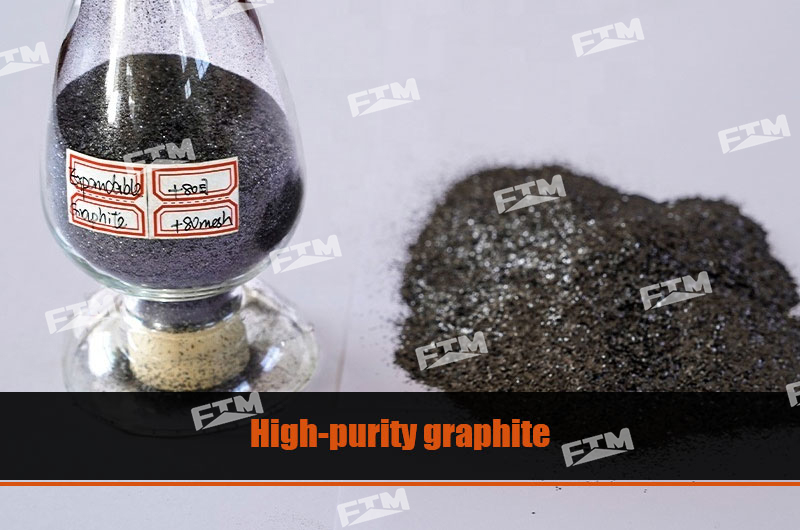
In graphite production, the primary challenge is preserving large flake graphite (+80 mesh), which commands a significant price premium over fine powders.
FTM Machinery adopts a multi-stage grinding and multi-stage separation strategy. Once graphite flakes are liberated from the gangue, they are immediately recovered to prevent damage from over-grinding.
| Graphite grade | Mesh size | Application | Market value |
| Extra large flake | +50 mesh | Expandable graphite, flame retardants | Highest |
| Large flake | +80 mesh | Refractories, high-end lubricants | High |
| Medium/fine flake | −100 mesh, −200 mesh | Battery anodes (after spheroidization) | Moderate |
Based on these requirements, a typical graphite beneficiation process includes crushing, controlled grinding, multi-stage flotation, followed by dewatering and drying.
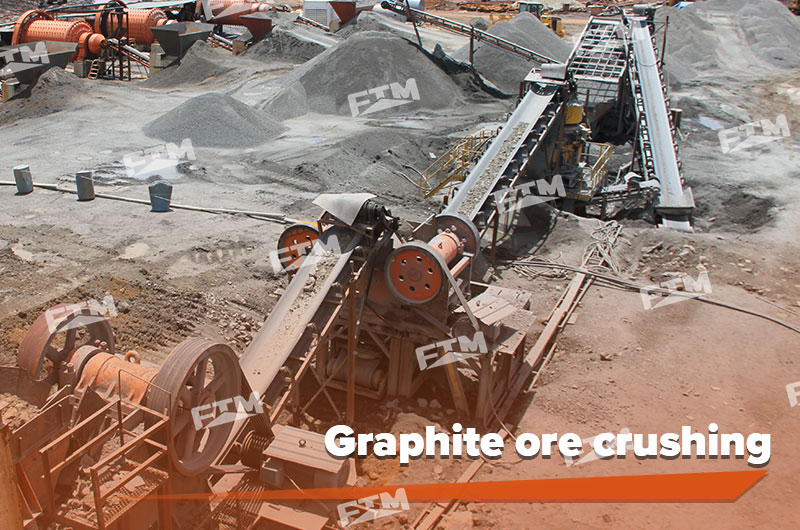
Graphite ore crushing
Raw graphite ore usually contains 3% to 15% Fixed Carbon (FC). The goal of the crushing circuit is to prepare a uniform feed for the grinding mills while minimizing dust.
- Primary crushing (Jaw Crushers): Designed for high-capacity reduction. A PE-series jaw crushers reduce raw ore up to 500 mm down to below 100 mm.
- Secondary/tertiary crushing (Cone Crusher): For graphite, hydraulic cone crushers are preferred for their ability to produce a consistent cubical shape, which improves the efficiency of the downstream ball mill.
Graphite ore grinding
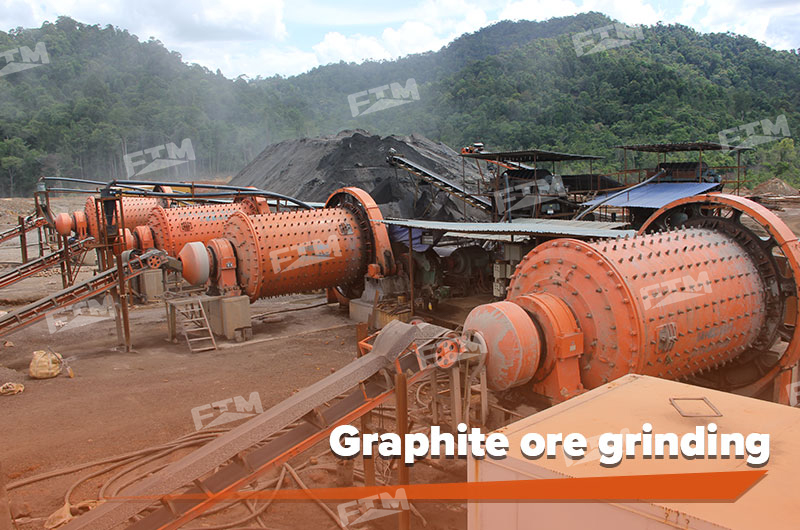
Over-grinding is the "profit killer" in graphite processing.
- Primary grinding (Rod Mills): Unlike ball mills, rod mills use "line contact" grinding. This exerts enough pressure to liberate flakes from quartz but prevents the "impact crushing" that shatters large flakes.
- Secondary regrinding (Overflow Ball Mills): Once the rough concentrate is collected, ball mills are used to "polish" the flakes, stripping away attached impurities (mica/silicates) to reach higher purity levels (>90%).
Graphite ore flotation
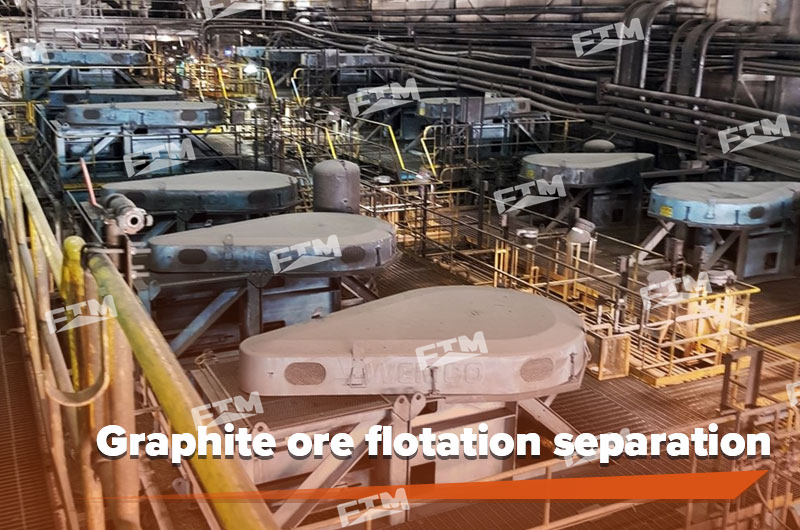
Graphite is naturally hydrophobic, meaning it clings to air bubbles while waste (gangue) sinks. However, reaching battery-grade purity requires multiple cleaning stages (typically 5 to 10 cycles).
The flotation circuit components:
- Roughing: Large-volume SF or XCF Flotation Cells remove the bulk of the waste (quartz/feldspar) quickly.
- Cleaning: The concentrate is reground and floated repeatedly. Each "cleaning" step inches the Fixed Carbon content closer to the 94-97% target.
- Collector: Kerosene or diesel (used at approx. 150-300 g/t). Frother: Pine oil or MIBC, used to generate stable and controllable bubbles.
Graphite ore dewatering and drying
Final concentrate emerges as a slurry (approx. 30-40% solids) and must be transformed into a dry, shippable product.
- Thickening: High-efficiency thickeners increase solids to 60%.
- Filtration: Automatic chamber filter presses reduce moisture to 15%. For high-capacity plants, this is the industry standard for cost-efficiency.
- Rotary drying: To meet export standards, final moisture content must be below 1%. Industrial Rotary Dryers ensure the flakes remain free-flowing without oxidation.
Each graphite deposit presents unique processing challenges. Selecting the right equipment and process flow is critical to achieving both high recovery and product quality.
For tailored graphite production solutions, equipment selection, or plant design support, consulting experienced beneficiation engineers can significantly reduce project risk. Contact us
Common graphite processing problems and solutions
Problem 1: Low concentrate grade
- Solution: Increase the number of cleaning stages and check for "locked particles" (graphite attached to quartz). A finer re-grinding stage may be necessary.
Problem 2: Loss of large flakes
- Solution: Reduce the grinding time in the primary circuit. Use a spiral classifier or hydrocyclone to quickly remove liberated graphite from the grinding loop.
Problem 3: High impurity (ash content)
- Solution: If graphite is associated with heavy minerals like pyrite, gravity separation such as shaking tables can be used before final flotation to reduce ash.